Sustainability
Keeping tomorrow in mind.
We are undergoing a transformation in order to enable change.
Yes, it is true that, currently, we are still largely transporting fossil natural gas through our pipeline grid, which is around 4,400 kilometres long. We are developing the hydrogen infrastructure and expanding the feed-in capacities for biomethane. In doing so, we are making an infrastructural contribution to the transformation of the regional energy system. At the same time, we are communicating transparently that natural gas will also remain a part of our transport portfolio in the coming years. Yet, the days of natural gas are numbered. We recognised these developments at an early stage. Starting from the natural gas transportation of today, we are continuing to gradually develop our grid for hydrogen and are increasingly integrating biomethane.
The challenge here is that we must achieve the one without abandoning the other. Yet, the existence of two systems - one for natural gas and one for hydrogen - also means increasing complexity in planning, construction, operation and maintenance – this poses challenges for us as a company. This is perhaps the most sweeping transformation process in our company's history. This process will take time and will not be achieved without facing conflicts and overcoming obstacles. However, the direction is clear and we are advancing step by step up the stairway to the future.
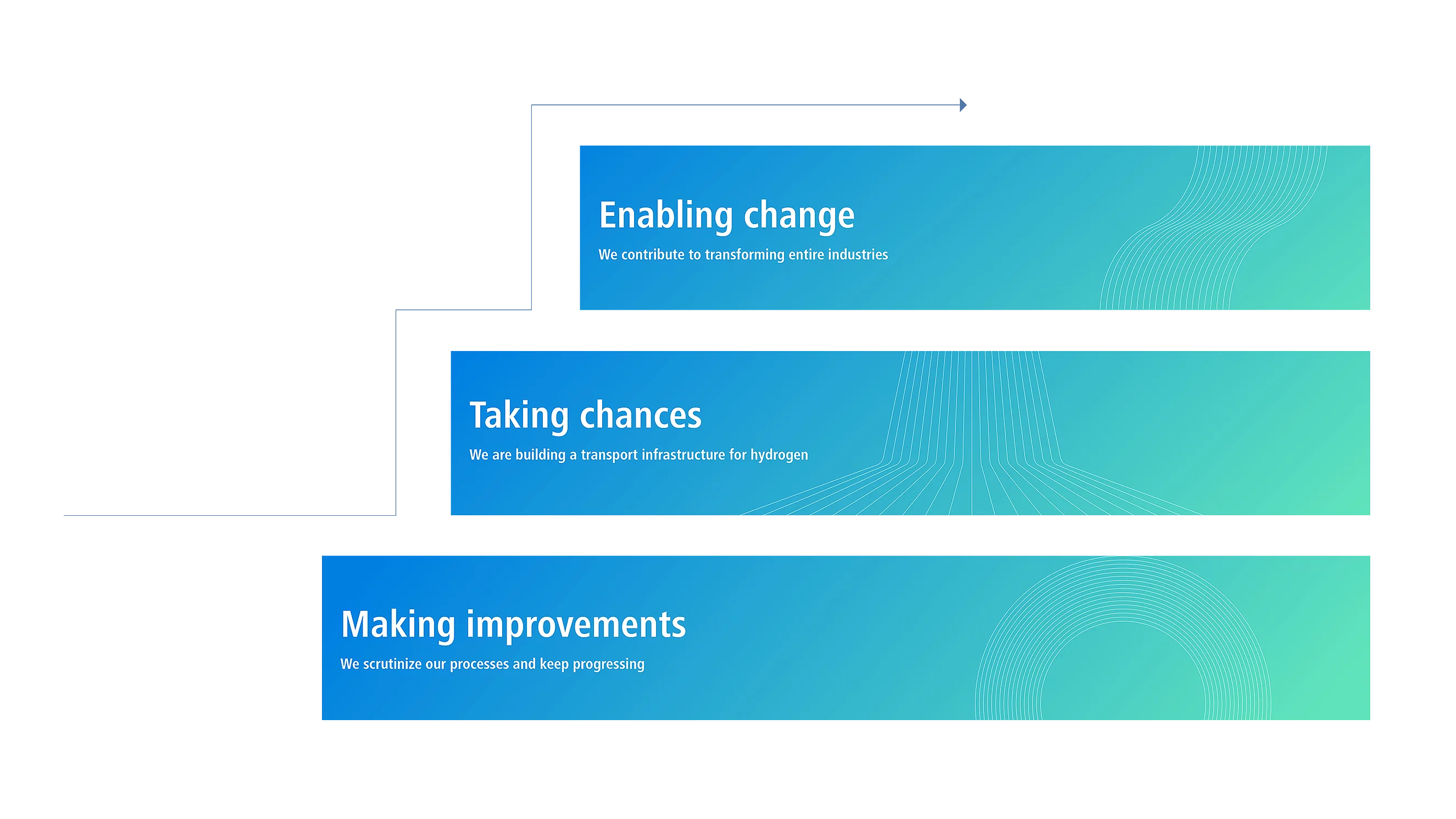
Enable change
Hydrogen can play an important role in hard-to-electrify industrial applications. There, hydrogen produced using renewable energy, in particular, can contribute to decarbonisation. Moreover, biomethane can replace fossil natural gas and cut emissions as a result. With our transport infrastructure we are creating connections between the producers, storage and importers of hydrogen and potential consumers.
Our key performance indicators
>> Sustainability report from p. 28
Since 2021, we have been reporting on our sustainability activities, measures, performance indicators and progress. To this end, we use an increasingly systematic approach to recording a large number of key performance indicators (KPIs). In preparation for reporting in accordance with the Corporate Sustainability Reporting Directive (CSRD), at the end of 2024, we introduced digital KPI management, which we are now continuously developing. Here is a small selection of our KPIs:
Our structures
and contact persons
At Thyssengas, sustainability is a collective task. Many of our business divisions contribute to the reduction of environmental impacts, the creation of safe and attractive working conditions and the assumption of social responsibility. In 2024, we adopted a sustainability guideline and this created a binding framework for sustainability as a collective task. We are proud of the many employees who are promoting this issue throughout the company.
Our sustainability officers, Henrik Schultz-Brunn and Timm Dominik, act as coordinators here between sustainability strategy development and its operational implementation. They are responsible for the internal and external communication of sustainability activities. They develop approaches to solutions together with experts in the respective areas, provide impetus and bring about company-wide policy decisions. If you have any questions or suggestions, please do not hesitate to contact our sustainability officers.