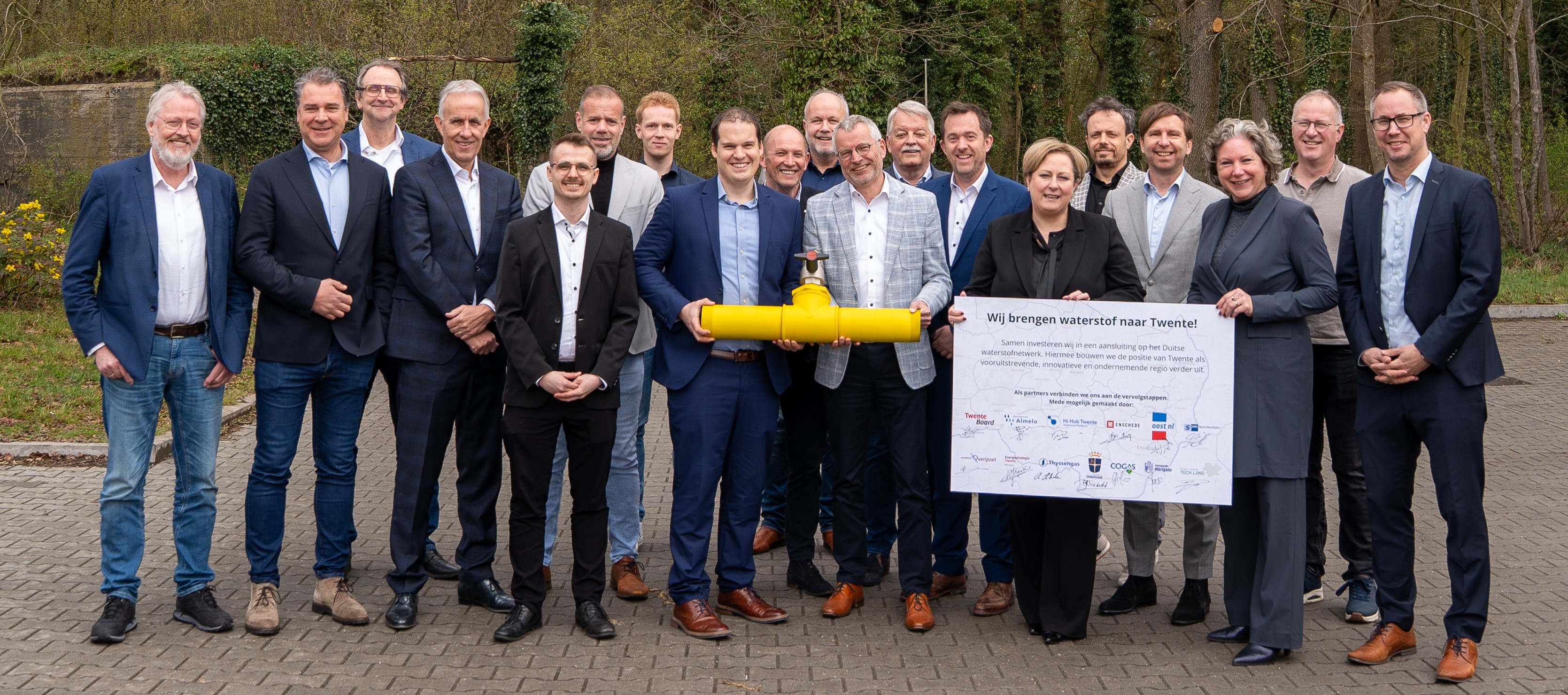
Dr Stefanie Kesting, CEO of Thyssengas, explains: “Together with Cogas, we have recognised the potential that cross-border partnerships offer for the ramp-up of hydrogen and have put this into practice. Through the T-junction, we are linking regional demand with European infrastructure. Our Vlieghuis-Ochtrup H2 pipeline thus opens up access to the Dutch import market and, by connecting the T-junction to the German core hydrogen network, strengthens the supply outlook for industry and small and medium-sized enterprises in the Twente region.”
Gerald de Haan, CEO of Cogas, explains: “Together with our partners from Twente and Germany, we are seizing this unique opportunity to connect to the German core hydrogen network. The energy system of the future cannot be powered by solar and wind alone. Sustainable molecules such as hydrogen are urgently needed. With this first step, we are preparing Twente for a future in which hydrogen becomes a valuable resource for our businesses and for the security of supply of our energy system.”
The T-junction is to be constructed in 2027 on Thyssengas’s Vlieghuis-Ochtrup H2 pipeline near Nordhorn. It will serve as a technical connection to a currently unused Dutch natural gas pipeline operated by Cogas, which will be converted for the transport of hydrogen in the future. This pipeline runs from the German-Dutch border to the south of Denekamp in the province of Overijssel. This will give the Twente region access to the hydrogen network, with a view to supplying local industry in Enschede, Hengelo and Almelo.
The connection of a Dutch distribution network operator to the H2 core network via a German transmission system operator is a first of its kind. With this project, Thyssengas is combining its strong regional roots in North Rhine-Westphalia and Lower Saxony with a cross-border perspective for the ramp-up of hydrogen.
Connection to the hydrogen core network
The planned T-junction will provide a connection to the Thyssengas Vlieghuis-Ochtrup pipeline, which is scheduled to come into operation at the end of 2027 according to the draft 2025 Network Development Plan. This will be the first cross-border hydrogen pipeline between the Netherlands and Germany. Construction work is currently underway to convert the 53-kilometre-long natural gas pipeline for the transport of hydrogen. The pipeline forms part of the Germany-wide hydrogen core network and the GET H2 hydrogen initiative, and secures access to the significant import market of the Netherlands.
The Vlieghuis-Ochtrup H2 pipeline offers the Twente region a decisive locational advantage: due to its immediate proximity to the German-Dutch border, the connection near Denekamp can already be realised via a roughly 300-metre-long pipeline to the T-junction. This will enable Twente to meet the expected demand for hydrogen from industry and small and medium-sized enterprises at an early stage and achieve its sustainability goals.
Cross-border partnership
In addition, a consortium of 13 partners has signed an agreement that goes beyond the realisation of the T-junction. Together, the German and Dutch partners reaffirm their commitment to building a regional hydrogen infrastructure in Twente. The aim is to ensure a comprehensive supply of hydrogen across the region and to deepen cross-border cooperation. The signing took place at the Twente Safety Campus in Enschede. Here, under the name ‘HyField’ and in cooperation with Cogas, a new hydrogen testing and training facility is being established, which is set to commence operations in summer 2026.
*The consortium comprises the following partners: Municipality of Enschede, Municipality of Almelo, Municipality of Hengelo, Municipality of Oldenzaal, Chamber of Industry and Commerce North Westphalia, Oost NL, TECHLAND, H2HUB Twente, Twenteboard, Energy Strategy Twente (RES Twente), Cogas, Province of Overijssel, Thyssengas.
Press contact:
Lena Behling
Project Communications Officer
Thyssengas GmbH
+49 231 91291 3932
presse@thyssengas.com