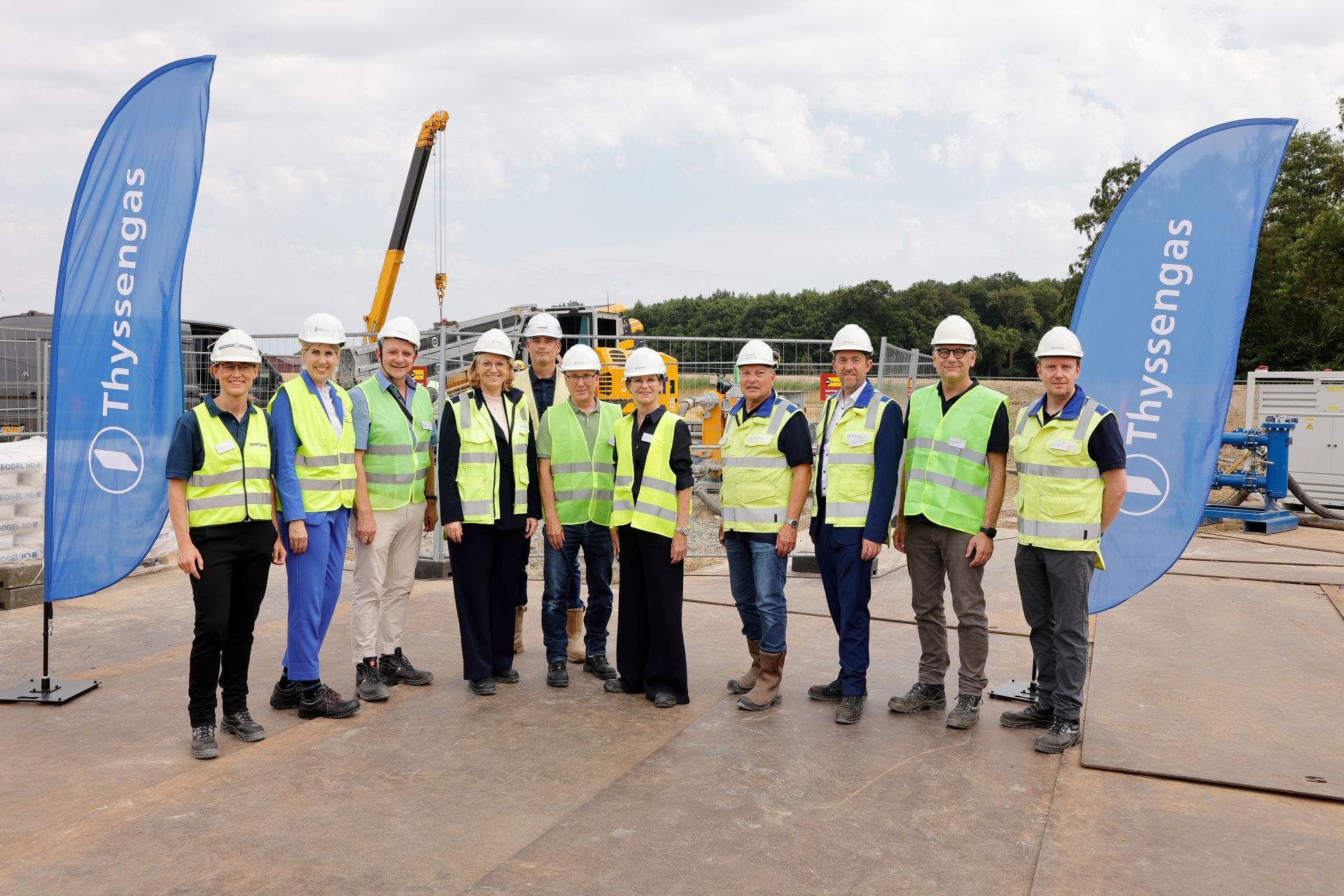
At the construction site in Münster-Amelsbüren, experts provided information about the Coesfeld–Rinkerode pipeline project and the next steps in its implementation. During a subsequent site tour, guests from the worlds of politics and business gained an insight into the technical requirements involved in tunnelling beneath the Dortmund-Ems Canal. The event clearly demonstrated how existing infrastructure is being retrofitted for the transport of hydrogen, thereby laying the foundations for new connection options in the region.
“The Coesfeld–Rinkerode hydrogen pipeline is a prime example of how we can make intelligent use of existing infrastructure for a climate-neutral energy supply,” says Dr Stefanie Kesting, CEO of Thyssengas. “With this culvert, we are closing an important gap in the pipeline route and creating the conditions for bringing hydrogen from the core network into the region. To ensure this leads to reliable supply prospects, Thyssengas, as a transformation partner, is supporting the collaboration between transmission system operators, regional distribution networks, industry, local authorities and policymakers, who are now jointly driving forward their plans for the future of energy.”
With the Coesfeld–Rinkerode hydrogen pipeline, Thyssengas is connecting the Münsterland and Westphalia regions to the emerging Germany-wide hydrogen core network. To this end, a former mineral oil pipeline approximately 45 kilometres long is being converted for the transport of hydrogen. The pipeline is to be connected in the Coesfeld area to the planned Emsbüren–Dorsten hydrogen pipeline and thus to the central north–south transport link. In Rinkerode, a future connection to the planned new Rinkerode–Hamm (Uentrop) H₂ pipeline is envisaged. The Coesfeld–Rinkerode H₂ pipeline is scheduled to come into operation at the end of 2027.
New connection beneath the Dortmund-Ems Canal
The crossing of the Dortmund-Ems Canal is a key component of the pipeline conversion. As part of the canal’s expansion in 2009, the former mineral oil pipeline was severed on both banks and the section running beneath the waterway was removed. Thyssengas is now re-establishing this connection to reactivate the pipeline. The new section of pipeline will be laid beneath the canal using the horizontal directional drilling method. To do this, a guided borehole will first be drilled beneath the canal bed. The borehole is then widened and the prepared pipe section pulled through. This allows the interrupted pipeline route to be reconnected without disrupting shipping traffic.
From the core network to consumers in the region
The hydrogen core network provides the basis for supra-regional transport. To ensure that hydrogen can also reach municipal, commercial and industrial consumers in future, additional regional distribution networks and specific connection pipelines are required. A T-junction integrated into the Coesfeld–Rinkerode pipeline creates the technical conditions for the regional onward transport of hydrogen. This branch is intended to connect the Thyssengas long-distance pipeline network with the downstream distribution network of Stadtnetze Münster. The close coordination between Stadtnetze Münster, the Janinhoff brickworks and Thyssengas illustrates how network operators and industrial customers can jointly develop connection and supply strategies right from the early planning phase.
“Every hydrogen infrastructure begins with the first metre of pipeline. Whilst the national core network is clearly gaining momentum, many legal issues remain unresolved at the distribution network level. With the T-junction, we as distribution network operators are therefore taking the lead and creating the technical conditions for a regional hydrogen distribution network in Münster,” explains Alexandra Rösing, Managing Director of the distribution network operator Stadtnetze Münster.
Dr Caroline Foyer-Clitheroe, Managing Director of Klinkermanufaktur
Janinhoff, emphasises: “We are already reliant on a piped hydrogen supply by the start of 2030 at the latest, simply to honour the climate protection agreement concluded in 2024 with the Federal Ministry for Economic Affairs. This will only be possible if the necessary connection between the transmission network and us as end users can be established by that time. The fundamental problem with the planned roll-out of hydrogen is, and remains, the connection of potential consumers via a distribution network. In this context, we are counting on the crucial support of the local network operator and political decision-makers.”
With the restoration of the canal crossing, the conversion of the Coesfeld–Rinkerode pipeline has reached an important project milestone. Following its planned commissioning at the end of 2027, the pipeline is set to open up new hydrogen supply prospects for local authorities, small and medium-sized enterprises and industry in the Münsterland region and Westphalia.
The Coesfeld–Rinkerode project at a glance
Project type: Conversion of an existing petroleum pipeline to hydrogen
Pipeline route: from Coesfeld to Rinkerode (near Drensteinfurt)
Pipeline length: around 45 kilometres
Pipeline diameter: DN 200
Planned commissioning: end of 2027
Current phase: Planning, preparation for construction and implementation of selective
construction works
Canal crossing: trenchless underpass beneath the Dortmund-Ems Canal using the
horizontal directional drilling (HDD)
Protective strips: three metres on either side of the pipeline axis