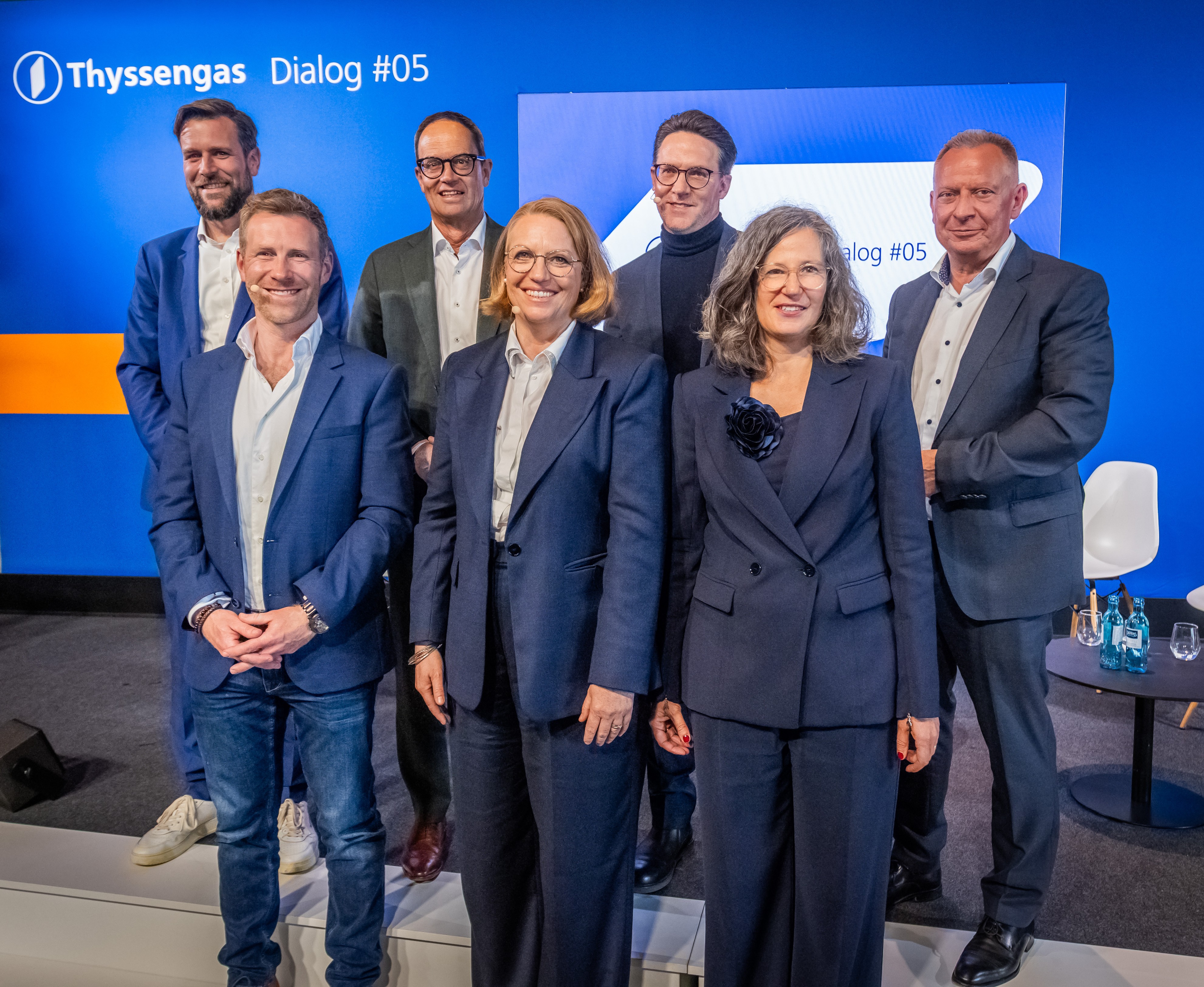
“North Rhine-Westphalia must remain a strong economic and industrial hub – today and for all future generations. To achieve this, we need a long-term framework and must consider infrastructure, energy sources and sectors as a whole: to ensure security of supply, resilience and decarbonisation,” said Dr Stefanie Kesting, host of the dialogue and CEO of Thyssengas GmbH, as she opened the event.
For Kesting, who has been at the helm of Thyssengas since the start of the year, one thing is clear: the gas market is changing – and with it, the demands placed on transmission system operators. The safe and reliable transport of gas remains the central task. Building on this, Kesting is further developing Thyssengas’s approach: the company sees itself increasingly as a transformation partner for industry, power stations, municipal utilities and regions.
The aim is to identify at an early stage which energy sources are needed, when and where, to pool demand and to bring together stakeholders along the value chain.
To this end, Thyssengas pursues a technology-neutral portfolio approach. Depending on the location and requirements, the company assesses which options are technically feasible, economically viable and compatible with future developments. “Industry needs guidance and concrete options: natural gas for a reliable energy supply, biomethane as an immediately available building block for decarbonisation, and hydrogen as a prospect for climate-neutral production processes,” says Kesting. Nevertheless, the political framework is important. “We are currently witnessing, in some cases, sudden fundamental political decisions at an ever-increasing frequency, compounded by geopolitical crises. The energy sector must not become a pawn of short-term political interests, geopolitical tensions and volatile societal expectations.”
Transformation becomes a location issue
Hardly any sector is under as much pressure as the steel industry. It must reduce CO2 emissions, remain internationally competitive and safeguard its production whilst continuing operations.
“The transformation of the steel industry marks a turning point in history. It requires a technological, organisational and economic reorganisation – with the aim of combining climate protection and competitiveness. For this to succeed, we need reliable framework conditions, competitive energy prices and an infrastructure that grows in step with the industry’s needs,” emphasised Dr Marie Jaroni, CEO of thyssenkrupp Steel Europe, during the event.
The green transition should not be seen as the end of industrial strength, but as the beginning of a new industrial era. She emphasised that industrial transformation and infrastructure development must go hand in hand. Green gases will only become a location factor if they are reliably available and arrive in good time where industry needs them. The steel industry can play a key role in the ramp-up of hydrogen – as an anchor customer and industrial driver.
The hydrogen ramp-up begins with production
Where will green gases, above all hydrogen, come from in future? Dr Max Ellerich, Business Development Director at Hystar, turned his attention to the production side. Hystar develops electrolysers and is thus working on a key prerequisite for the hydrogen ramp-up. For Ellerich, one thing is clear: the technology is evolving rapidly and offers great potential for producing hydrogen more efficiently and cost-effectively in the future. The crucial step now is to build confidence in the technology and demonstrate through concrete projects that it works on an industrial scale. This requires the courage to take action – as well as reliable framework conditions and concrete purchase commitments.
H2 value chain: from import to consumer
Whether the hydrogen ramp-up succeeds will be decided at the interface between import, transport and consumption. Jan Eisenberg, Head of Network Partners and Technical Contracts at Thyssengas, explained how Thyssengas is bringing together international import prospects with specific demand in North Rhine-Westphalia. Ulrich Reuter, NRW representative of the Port of Rotterdam, along with Sebastian Kaemmer and Harry Smit from Hynetwork, a subsidiary of the Dutch gas network operator Gasunie, outlined the role of Dutch hydrogen imports for NRW. It became clear that the ramp-up of green gases requires cross-border cooperation – and a link to concrete regional supply prospects.
The planned H2 network expansion in the Düsseldorf/Neuss area illustrates how this can be achieved locally. Ansgar Taubitz, Strategy Officer at Thyssengas, explained how Thyssengas is pooling regional demand, developing clusters and preparing extensions to the core H2 network. The case study shows that even though the regulatory framework has not yet been fully clarified, Thyssengas is driving forward regional network planning at an early stage and bringing local partners together.
“For us municipal utilities, what matters is whether hydrogen can be planned for locally. Businesses and local authorities need concrete prospects for connection and supply. Only then can we invest, plan and actively shape the region’s transformation,” emphasised Thomas Walkiewicz, Managing Director of Stadtwerke Neuss.
Transformation is decided in the regions
Stephan Pusch, District Administrator of the Heinsberg district, and Guido Beckers, Managing Director of BMR energy solutions, also highlighted the particular importance of regional projects. Using the H2HS project as an example, they demonstrated how hydrogen supply can be conceived and prepared from within the region, in collaboration with local authorities, industry and infrastructure partners.
“We need a sort of business plan for the regions: where do we want to go, what can we initiate locally ourselves, and where do we need external support? The first step is local networks. That is where it becomes clear which projects are actually feasible and which partners are needed for them,” said Stephan Pusch.
Biomethane as a pragmatic building block of decarbonisation
In addition to hydrogen, the dialogue also focused on the role of biomethane. In a practical presentation, Jan Müller, Managing Director of Shell Germany Biogas, Dr Marc Fiebrandt, Strategy Officer at Thyssengas, and Sascha Tenholter, Biogas Team Leader at Thyssengas, explained how this energy source can already contribute to reducing emissions today. Shell and Thyssengas are working to make biomethane usable via existing gas infrastructure and feed it into the grid. It became clear that biomethane can strengthen the resilience of the energy supply because it is storable, capable of providing base load, firmly established across Europe and locally available.
The ramp-up of green gases requires leadership and collaboration
In the concluding panel discussion , Dr Stefanie Kesting, Dr Kirsten Westphal, a member of the BDEW’s Executive Board, Dr Gerhard Holtmeier, Chairman of the Management Board of DEW21, Stephan Pusch, Dr Max Ellerich and Jan Müller discussed the conditions that must now be created for a successful transformation. There was agreement that the restructuring of the energy system can only succeed if we work together. The framework conditions remain challenging, economic viability is a key prerequisite, and the task of transformation is immense. This makes it all the more important for people and companies to take responsibility and take concrete steps. This requires an integrated view of electricity and gas infrastructure and closer collaboration between industry, local authorities, network operators and policymakers. Only in this way can security of supply, climate protection, resilience and economic viability be combined.
“Transformation will not succeed if everyone waits for perfect conditions,” concluded Dr Stefanie Kesting. “It succeeds when stakeholders reach out to one another at an early stage, identify common interests and provide each other with investment certainty in order to move towards implementation. This is precisely why we established the Thyssengas Dialogue in 2022 as a platform – as a starting point for further discussions, new impetus and joint collaboration on concrete solutions.”
The recording of the Thyssengas Dialogue #05 is available at www.thyssengasdialog.com.