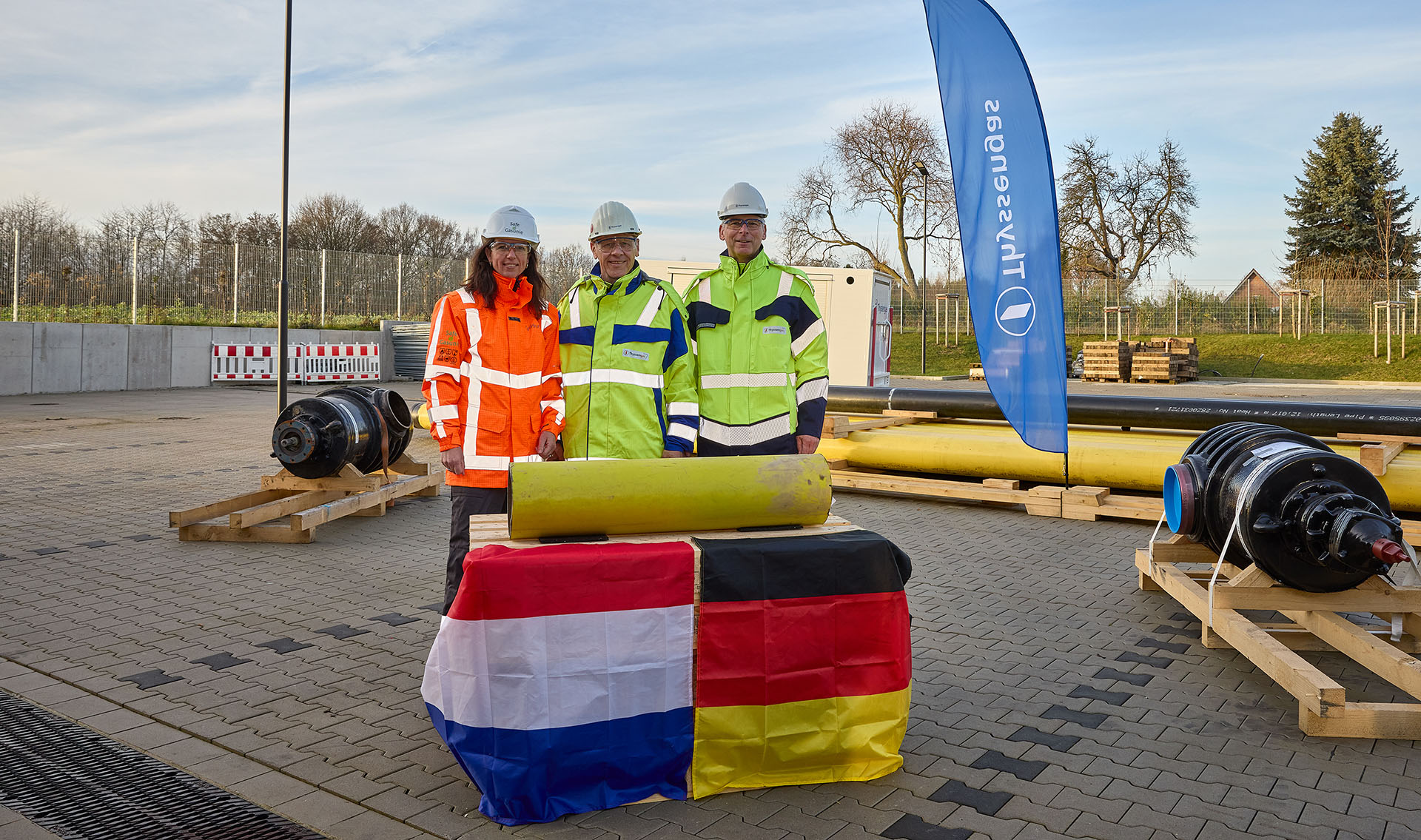
A central strategic corridor is to be established via the border points at Oude Statenzijl (Groningen) and Vlieghuis (Drenthe), linking Dutch industrial areas, import routes via Dutch ports, and storage and production facilities directly with industrial areas in Germany – particularly in the Ruhr region and the Rhineland – and the markets of north-western Europe. The pipeline system will then be used for the first cross-border hydrogen transport between Germany and the Netherlands, supplying the first launch customers.
Thyssengas is contributing its existing natural gas pipeline between Vlieghuis in the Netherlands and Ochtrup in North Rhine-Westphalia to the project. Conversion work began as early as this summer. The pipeline is also part of the Germany-wide core hydrogen network and the GET H2 hydrogen initiative.
Support for industrial decarbonisation in the Ruhr region and the Rhineland
The agreement defines key technical and organisational parameters that are essential for safe and reliable cross-border hydrogen transport. The signing of the agreement lays an important foundation: it is a first step towards the full realisation of several cross-border hydrogen transport links between the Netherlands and Germany.
Helmie Botter, Director of Hydrogen Transport at Gasunie, explains: “Cross-border trade and transport of hydrogen is crucial for a well-functioning hydrogen market in north-western Europe. The agreement reached not only enables transport via our infrastructure between the Netherlands and Germany, but also to and from Denmark. We are striving to create an integrated hydrogen market and are working closely with our partner network operators to make cross-border transport as straightforward as possible.”
Dr Thomas Gößmann, CEO of Thyssengas: “The signing of this contract marks a significant milestone in the expansion of the international hydrogen infrastructure. We are particularly proud that our Thyssengas pipeline from Vlieghuis in the Netherlands to Ochtrup in North Rhine-Westphalia will make a valuable contribution on several levels: It enables cross-border hydrogen transport between Germany and the Netherlands, supports the development of the German core hydrogen network, and drives industrial decarbonisation in the Ruhr region and the Rhineland through its connection to the GET H2 system.”
Dr Thomas Becker, Commercial Director at Thyssengas, adds: “Hydrogen is a key driver for a more sustainable energy supply. The decarbonisation of industry in the Ruhr region and the chemical sector in the Rhineland – regions where Thyssengas is primarily active – is crucial for achieving climate targets. Hydrogen plays a key role in this transformation: as a CO₂-free energy carrier, it enables energy-intensive processes such as steel and chemical production to make the transition from fossil fuels to sustainable alternatives. The agreements on cross-border hydrogen transport infrastructure represent an important milestone – not only in the development of this network, but also in advancing the shared goal of climate neutrality.”
Michael Theben, Head of Department at the Ministry of Economic Affairs, Industry, Climate Protection and Energy of the State of North Rhine-Westphalia: “North Rhine-Westphalia is the industrial heart of Germany and one of Europe’s most important industrial locations. Our task is to make this location climate-neutral and thus future-proof. The agreement between Thyssengas, Gasunie Deutschland and HNS on cross-border hydrogen transport between the Netherlands and North Rhine-Westphalia is an important milestone in this regard: the transport strengthens security of supply, connects us to major import routes and provides planning certainty for businesses and local authorities. The GET H2 initiative exemplifies how the energy transition is being advanced collaboratively across the entire value chain – from hydrogen production through transport to utilisation. As the state government, we strongly support this approach.”
Press contact:
Annika Preuß
Press Officer, Project Communications
Thyssengas GmbH